 DOI :
DOI :
 Vistas: 382



 |
 |
 |
 |
 |
About the Journal
Política Internacional is a peer-reviewed, open access scientific journal in Diamond/Platinum OA modality, edited and published quarterly by the University of International Relations “Raúl Roa García” (ISRI), of Cuba.
Its objective is to contribute to the study, research, and development of political science, with a special emphasis on international relations, as well as the analysis of international politics from an interdisciplinary perspective.
The journal is aimed at academics, researchers, students, professionals, and decision-makers in the field of international relations and political science, as well as those interested in the study and analysis of international politics, Cuba, and the rest of the world.
It mainly publishes original research articles, as well as systematic or narrative reviews and reflection articles, which form the core of its scientific content. In addition, it considers empirical or theoretical research notes, interviews with prominent figures in the field of international relations, and critical reviews of recent books or research of academic relevance.
It accepts and publishes contributions in Spanish, English, French, and Portuguese.
The submission of manuscripts, processing, evaluation, editing, and publication are completely free of charge (no article processing charges - APCs). There is no commercial or profit-making use. Each published issue is made available free of charge and immediately.
All content in the journal is licensed under the Creative Commons Attribution-NonCommercial International 4.0 License (CC BY-NC 4.0).
The journal is certified by CITMA, registered in the National Registry of Serial Publications (No. 2092, Folio 098, Volume III), and has an online ISSN (2707-7330) and a print ISSN (1810-9330). It is also indexed in recognized international databases, catalogs, search engines, directories, and repositories.
Current Issue
Vol. 8 No. 3 (2026): (julio-septiembre)
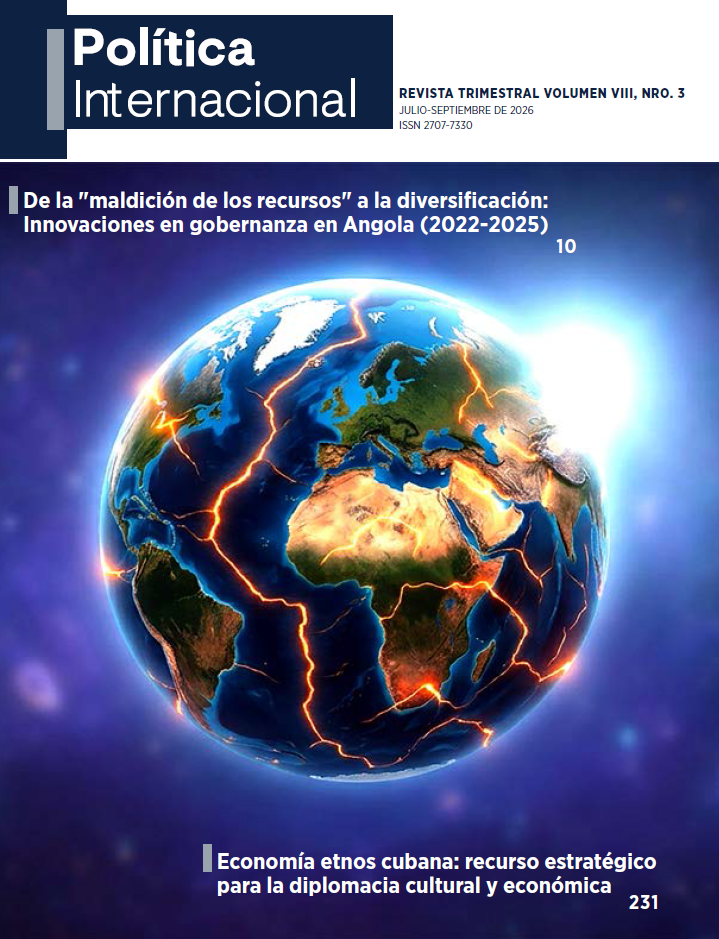
This third issue of 2026 offers an analytical mosaic that, from a diverse geographical and methodological perspective, examines core themes of global governance, contemporary diplomacy, and international relations theory. The section "The World We Live In" dissects key processes in the Global South, from economic diversification in Angola and Ethiopia's integration into the BRICS, to institutional reform in Vietnam and digital government models in Latin America, while also incisively debating the illegitimacy of US hemispheric control and the historical role of the Cuban-American community. Meanwhile, "Cuban Diplomacy" revisits key trajectories—from Che Guevara's tricontinental campaign to cooperation in Africa and tourism integration in the Caribbean—and examines the resilience of cultural diplomacy in the face of hostility from three US administrations, as well as Spanish-Cuban ties from a little-explored cultural perspective. In International Relations, the theoretical reflection questions the relevance of the "Third World" concept, unravels the meanings of multipolarity, and analyzes humanistic exchanges with China, while proposing a renewed notion of civility based on popular political participation and contextualizing Russian foreign policy within the framework of a multipolar order. The Student Scientific Lens and Notes section enrich the dialogue by addressing ALBA-TCP, the distinguished career of Jorge Alberto Bolaños, and the reinvention of the Monroe Doctrine. We invite our readers to explore its pages and foster critical reflection on the reconfiguration of the multipolar order, the challenges of South-South cooperation, and the geopolitical tensions that define our time.
Published:
2026-07-07
Full Issue
THE WORLD IN WHICH WE LIVE
CUBAN DIPLOMACY
INTERNATIONAL RELATIONS
STUDENT SCIENTIFIC LENS
NOTES
INDEXATIONS:
 |
 |
 |
 |
 |
|
|
 |
|
|
 |
 |
 |
 |
 |
 |
 |
 |
 |
 |
 |
 |
 |
 |
 |
 |
 |
 |
 |
 |
 |
 |
 |
 |
 |
 |
|
 |
 |
||