INTRODUCTION
Indonesia and Cuba established diplomatic relations on 22nd January 1960. In 2025, both countries celebrated 65 years of anniversary of diplomatic relations. Indonesia and Cuba are old friends, in which Indonesia’s first President, Soekarno paid an official visit to Cuba in May 1959 and had a very close friendship with the Cuban leaders including President Osvaldo Dorticós Torrado, Prime Minister Fidel Alejandro Castro Ruz, and Ernesto "Che" Guevara. They shared common understandings of anti-imperialism and anti-colonialism, and strong solidarity among the global south nations during the decolonization period. This historical friendship continues to be a memorable diplomatic footprint between the two countries.
In the political sphere, over the years both countries continue to show strong cooperation through high-level official visits and mutual support in various international fora to advance the global south common interest on the South-South cooperation agenda. Meanwhile in the economic sphere, in 2024 the bilateral trade relations amounted to US$10.5 million (Trade Map, 2025). Indonesia’s main export to Cuba are: soap, palm oil, vaccines, and sacks and bags. Meanwhile Cuba’s main export to Indonesia are: cigarettes, imunnological products, cigars, animal raw hides and skins, and rum or other spirits. Apart from trade, there are several Indonesian investment in Cuba in the hospitality sector, and over the years Indonesia offered capacity building program as part of the technical cooperation. In the socio-cultural sphere, people to people contact is still relatively limited, as there are few Indonesian citizens live in Cuba and vice-versa. There are socio-cultural cooperation initiatives, mainly focused on sports, health, education, and research sectors. Also, Cuba’s initiative on international humanitarian and medical diplomacy efforts in Indonesia during the Tsunami in Aceh (2004) and the earthquake in Yogyakarta (2006) (Luska, 2025).
The bilateral relations between the two countries are positive and cordial, but the economic relations seem to be limited and below its potentials. More efforts should be undertaken to further strengthen the bilateral economic relations. This study attempts to identify and search ways to strengthen the bilateral economic relations. So far, relatively few studies have been conducted on Indonesia-Latin American relations and as well as Indonesia-Caribbean relations, particularly on Indonesia-Cuba relations.
Sjahril (2020) wrote that since 2005, Latin America has gained increasing attention in Jakarta and with renewed interest. Over the years, Indonesia has cordial relationships with the Latin American states and is an opportunity to turn this positive political relationship into a thriving economic relationship including boosting trade, tourism, investment and services relations. Latin America can be an alternative source of energy (particularly oil and gas, and now critical minerals), agro-industry cooperation, and technical and development cooperation for Indonesia. Meanwhile Latin America can find in Indonesia a potential hub in South-East Asia.
But there are structural and objective challenges to enhancing Indonesia Latin America relations including geographical distance with no direct flights or shipping transportation, high transportation costs, poor infrastructure and connectivity, and trade barriers (tariff and non-tariff barriers) may hinder the strengthening of commercial ties (Sjahril, 2020). Further, a lack of historical connections and mutual knowledge, cultural differences, language barriers, limited mutual interest and scarce access to information are also challenging factors.
Sjahril (2017) identified using a gravity model approach, he discovered that three variables, namely Latin American countries’ GDP, the establishment of Indonesian embassies in Latin America and of Latin American embassies in Indonesia, and the number of MOUs can have a positive effect on Indonesia-Latin America bilateral trade performance.
At the bilateral level, there are some previous studies on Indonesia’s relations with the Latin American counterparts such as (but not limited to) Chile, Peru, and Argentina. The joint National Research and Innovation Agency (BRIN)–Ministry of Foreign Affairs of the Republic of Indonesia policy paper (2025) shows that Chile is an economically stable market and increasingly strategic for Indonesia, especially after the entry into force of the Indonesia–Chile Comprehensive Economic Partnership Agreement (IC-CEPA). Further, Indonesia’s trade balance with Chile has been consistently positive, while several commodities such as automotive products, footwear, chemical products, and paper have been mapped as having the strongest export opportunities. Meanwhile, Al-Husin & Virgianita (2024) found that the relationship between Indonesia and Chile in various fields shows a fluctuating trend because both nations still focus on traditional partners, the relationship between the two countries is pragmatic, lack of political will, and lack of information about each other's characteristics.
Firdaus & Nurhayati (2020) revealed that the recent Indonesia-Peru plan to improve economic cooperation can be the first step for Indonesia to start diversifying markets and opening new markets, especially new markets in Latin America. Using the Trade Complementarity Index (TCI), showed the level of complementarity of the exports of the two countries falls into the moderate category of trade complementary, and the Export Product Dynamic (EPD) analysis showed that the market position of most of the Indonesian commodities studied shows a favorable
position (rising star position), meanwhile Peruvian export cooperation to Indonesia has great potential in the five commodities studied. Further, the Global Trade Analysis Project (GTAP) analysis showed that the Indonesia-Peruvian PTA policy will benefit both countries.
Diphda et al (2025) explained why Indonesia decided to sign the Indonesia-Peru Comprehensive Economic Partnership Agreement (CEPA) dated on 11 August 2025 using the three-motive lens: economic, security, and leverage. From the economic perspective, the CEPA addresses discrimination risks by removing most tariffs at entry into force and clarifying rules of origin, customs, and cooperation on technical barriers to trade and sanitary and phytosanitary measures. The security motives are visible in the presidential ceremony tied to 50 years of diplomatic relations, a joint declaration, and a parallel cooperation memorandum that widens cross-regional engagement with an Latin American partner. Leverage motives appeared in the committee structures that build capacity for later talks.
Rubiolo & Ramoneda (2012) discussed Indonesia-Argentina relations in which Argentina views Association of Southeast Asian Nations (ASEAN) particularly Indonesia as the biggest economy in the ASEAN region provides major potential market for Argentina as part of the trade diversification strategy. The study stated that Argentina’s relations with Indonesia will receive greater importance on the Argentina’s foreign policy agenda in the years to come. Other study, Rubiolo (2014) viewed that there are increasing interest in the context of South-South cooperation in the South America’s foreign policy agendas, and thus, strengthening trade relations with the Southeast Asian nations become more relevant for the South American foreign agenda, and Argentina is no exception in this trend. Indonesia is becoming an Asian axis for Argentina’s trade insertion, and Argentina did a political approach with the high-level visits to Indonesia in opening avenues for trade diversification. Further, it is suggested the cooperation should be multidimensional including energy, science and technology, and cultural cooperation.
This paper attempts to identify and map potential trade and investment cooperation opportunities between the Indonesia and Cuba to strengthen the bilateral economic relations. It is expected with the guided market intelligence analysis of both countries’ economic structures, and as well as the market and investment needs, both countries can leverage their sectoral advantages to develop a more comprehensive and mutually beneficial economic relations. Economic diplomacy is clearly a priority agenda in both countries' foreign policy to support national economic development agenda. Therefore, this study is needed to enhance the bilateral economic relations, as currently still relatively limited and below its potentials. The study is also expected to contribute in enriching scientific economic and international relations literatures, particularly in the field of the international trade and economic diplomacy issues. For the policymakers, this research may be used as one of the guidances for the Indonesian and Cuban government to take the appropriate economic diplomacy measures on strengthening Indonesia-Cuba bilateral trade relations
Research Methodology and Data
This study utilizes a market intelligence approach to analyze the potential trade and investment opportunities between Indonesia and Cuba, followed by the analysis of the potential economic impact of Indonesia-Cuba free trade simulation, discussion on the potential and opportunities for other economic and socio-cultural cooperation between the two countries, and finally, the conclusion and policy recommendation. The analytical framework used in this study can be seen in detail in Figure 1 below.

- Source: Authors (2025)
The first part, the study uses Revealed Comparative Advantage-Constant Market Share Analysis (RCA-CMSA) Product Classification Model, developed by Verico (2020, 2022, 2025), and later further jointly developed (remodified) Verico-Center of Policy Strategy for Special Issues and Data Analysis (2025) which enables a systematic mapping of products with comparative advantages and dynamic market trends. The research utilizes a combination of Revealed Comparative Advantage (RCA) and Constant Market Share Analysis (CMSA) to highlight competitive products and also identify those with sustainable growth potential, making it a valuable tool for crafting long-term trade and investment strategies (Verico, 2020).
The RCA index is originally introduced by Balassa (1965), which uses the index to measure the comparative advantage of a country’s export products relative to global export patterns. Meanwhile, CMSA is firstly introduced by Tyszynski (1951) aims to further explore the export growth and competitiveness of commodities traded between the two countries. The CMSA captures the market share dynamics of products over time and it allows the trends identification in product competitiveness within the country’s market.
Several previous studies have used the RCA-CMSA product classification model, including Kurniawan (2024) to get a nuanced understanding of the competitiveness of traded commodities between Indonesia and Sudan, which is essential for evaluating the potential benefits of deepening trade ties through an RTA. Ragimun et al (2022) utilized the RCA-CMSA matrix analysis to identify potential trade and investment cooperation between Indonesia and China in the Regional Comprehensive Economic Partnership (RCEP). Ragimun et al. (2022) proposed using RCA-CMSA model to categorize traded commodities between trade partners, and this approach mirrors the Boston Consulting Group (BCG) Matrix, which was originally developed to guide companies in prioritizing their various business units (Drummond et al., 2008). By applying a similar matrix to trade analysis, the model can provide a nuance understanding of the competitive positioning of different commodities within international trade agreements. Other study, Ristanto (2024) used the RCA-CMSA estimation to identify the potential commodities that intensify trade and investment between Indonesia and Eurasian Economic Union (EAEU) member countries. Sinta et al (2026) utilized RCA-CMSA Product Classification Model to identify potential trade and investment opportunities between Indonesia and Angola, and found that Indonesian export opportunities including palm oil and ferro alloys; meanwhile, Angolan export opportunities includes petroleum and gas. In the investment sphere, Indonesian potential inbound investment from Angola includes cocoa and coffee, and suggested Indonesian outbound investment in Angola refers to the investment offer by AIPEX and Angola's SEZs to support Angola’s economic diversification agenda.
This study utilizes modified RCA-CMSA Product Classification Model as guided by the economic intelligence guidebook published by Center of Policy Strategy for Special Issues and Data Analysis (2025). The model still refers to the Verico (2020) RCA-CMSA Product Classification Model, using the CMSA3, the competitiveness effect or national global factor, which is a key indicator of a country's ability to maintain or increase market share amid competition. The CMSA3 (comparative factor) parameter is able to identify the competitiveness performance of a country's export products in the destination market.
The RCA-CMSA Product Classification Model analysis compares the competitiveness of products globally and classifies them into four categories, namely: Great (RCA>1; CMSA>0), Sunrise (RCA<1; CMSA>0), Sunset (RCA>1; CMSA<0), and Saturated (RCA<1; CMSA<0) (Verico, 2020). Using this product classification analysis between two states, the study could provide economic diplomacy recommendation in four categories: export strategy, import strategy, outbound investment strategy, and inbound investment strategy (Center of Policy Strategy for Special Issues and Data Analysis, 2025) (see table 1).
In this study, the RCA calculation uses 2023 data to assess the competitiveness position of Indonesia’s products in the Cuban market, and vice versa. Meanwhile, CMSA is applied to analyze the market share dynamics of these products over two time periods, namely 2021 and 2023, in this case the CMSA results are used to see the dynamics of changes in the competitiveness of Indonesian products in the Cuban market, and vice versa. The data used in this study are sourced from TradeMap, with product classification based on Harmonized System at the 4-digit level (HS-4), covering the period from 2021 to 2023.
Table 1. RCA-CMSA Product Classification Model
RCA-CMSA3_RI |
RCA-CMSA3_CUBA |
Economic Diplomacy Recommendation |
Great |
Saturated |
Export |
Great |
Great |
Import |
Great |
Sunrise |
Export |
Great |
Sunset |
Export |
Saturated |
Great |
Import |
Saturated |
Saturated |
Import |
Saturated |
Sunrise |
Import |
Saturated |
Sunset |
Import |
Sunrise |
Great |
Import |
Sunrise |
Saturated |
Export |
Sunrise |
Sunrise |
Import |
Sunrise |
Sunset |
FDI Outbound |
Sunset |
Sunrise |
FDI Inbound |
Sunset |
Saturated |
Export |
Sunset |
Sunset |
Import |
Sunset |
Great |
Import |
- Source: Modified from Center of Policy Strategy for Special Issues and Data Analysis (2025)
From the RCA-CMSA product mapping results, the study identifies the top 10 priority products for economic diplomacy strategy, namely the suggested trade strategy (exports and imports) and investment strategy (inbound and outbound). The top priority products are ranked based on the trade data 2023, specifically for the Indonesian export strategy is based on the Indonesian export to the world, the Indonesian import strategy is based on the Indonesian import from the world, Indonesian inbound investment from Cuba is based on the Indonesia's export value to Cuba, and Indonesian outbound investment from Cuba is based on the Indonesia’s import value from Cuba.
For the second part, the study assesses the potential economic impact of the Indonesia-Cuba bilateral free trade agreement scenario. The study uses TINA (Trade Intelligence and Negotiation Adviser) model approach, an online partial equilibrium analysis dashboard developed by the United Nations Economic and Social Commission for Asia and the Pacific (UNESCAP) (Trade Intelligence and Negotiation Adviser, 2025). The TINA model aims to assist trade policymakers and researchers in carrying out analytical tasks commonly conducted as part of trade agreement negotiations, and one of the features is a partial-equilibrium model dashboard1 to assess the potential economic impact of reduced tariffs (UNESCAP, 2025a). For this study uses 6-digit level (HS-6) product classification Harmonized System (HS) code data and based on trade data year 2024 and only covers primary and manufactured goods.
Various previous studies have used TINA model to assess trade policy changes (including change in tariff policy). For instance, the Bangladesh-India trade agreement feasibility study; the studies of the potential effects of India-EU and India-UK trade agreements; and the study of the potential of the Mongolia-Republic of Korea trade agreement (UNESCAP, 2025b). Rashid (2025) also used TINA tool to quantify Bangladesh’s preference-erosion risk after LDC (Least Developed Country) status graduation and estimates post-graduation trade losses of Bangladesh ranging from USD 4.7 billion to USD 17 billion, while emphasizing vulnerabilities such as export concentration and weak diversification, recommending smooth transition strategies with a coordinated planning.
The third part of this study introduces Indonesia-Cuba diplomatic relations, followed by discussion of the broader prospects for bilateral economic cooperation complemented with potential socio-cultural cooperation and South-South cooperation agenda by incorporating insights from the relevant references and secondary data sources. The findings subsequently inform as inputs for evidence-based policy recommendations designed to strengthen the economic diplomacy agenda between Indonesia and Cuba, with a particular emphasis on advancing trade and investment relations. Finally, in the last section, the paper attempts to provide economic diplomacy recommendations for the Indonesian and Cuban policymakers.
The study uses primarily the secondary data and will be collected from the open resources such as online trade database and journals, and relevant websites. For instance, for the source of trade data will be based on the World Integrated Trade Solution (WITS) database jointly developed by the World Bank and the United Nations Conference on Trade and Development (UNCTAD), TradeMap, and TINA. In general, the scope of this research covers: a) The number of countries observed are 2 states, Indonesia and Cuba; and b) For the trade data, product classification Harmonized System data (HS code) will be used to conduct the research.
Robustness Analysis and Limitations of the Results
The empirical analysis using the RCA-CMSA product classification model and TINA model is based on quantitative models that provide a systematic overview of product mapping with comparative advantages and dynamic market trends, as well as the potential trade impact of a change in trade policy (tariff changes). However, these models have inherent limitations. TINA, as a partial equilibrium model has several weaknesses, including: it neglects the interactions and feedbacks between the various markets or the inter-sectoral input/output linkages that are typically captured in general equilibrium model; and it does not fully account for constraints applied to the various factors of production and their movement across sectors.
Meanwhile, the RCA-CMSA product classification model identifies suggested economic diplomacy strategies (trade and investment strategies) based on comparative advantage and dynamic market trends under the assumptio of ceteris paribus (holding other factors constant). Consequently, the model may overlook other important determinants of economic diplomacy strategies, such as structural constraints (including logistics cost), geographical distance, and even geopolitical factors such as the U.S. sanctions on Cuba that could hinder the realization of the identified economic diplomacy strategies. To address these limitations, this study complements the quantitative analysis with a qualitative discussion of Indonesia – Cuba diplomatic relations and broader prospects for bilateral economic cooperation, including socio-cultural cooperation and the South-South cooperation agenda, based on relevant literature.
DEVELOPMENT
Results and Discussion
In this section, the results and discussion of the market intelligence analysis of Indonesia-Cuba economic relations are divided into 3 (three) main sections. The first section presents the identification and mapping of Indonesia's potential products to Cuba (and vice versa) using the RCA-CMSA Product Classification Model for economic diplomacy recommendation (trade and investment cooperation). The second section discusses the potential economic impact of Indonesia-Cuba free trade simulation using the TINA model, a partial equilibrium analysis dashboard. The third section discusses the potential and opportunities for other economic and socio-cultural cooperation between Indonesia and Cuba.
Indonesia-Cuba Potential Product Identification and RCA-CMSA Product Mapping Results
The results of the RCA–CMSA product mapping analysis show that there are 862 potential HS-4 product combinations between Indonesia and Cuba. Based on the RCA–CMSA product classification model, Indonesian export opportunities to Cuba accounting for 359 products, meanwhile Indonesian potential import opportunities from Cuba totaling 473 products. In addition, foreign direct investment (FDI) opportunities were identified on both sides, a total of 4 products fall into the Indonesian FDI outbound in Cuba, specifically from category sunrise Indonesia–sunset Cuba. Meanwhile, there are 26 products of the potential Indonesia FDI inbound from Cuba, based on the sunset Indonesia–sunrise Cuba matrix, highlighting a narrow but focused opportunity for investment cooperation between the two countries.
In summary, the RCA–CMSA matrix between Indonesia and Cuba reveals opportunities for bilateral trade and investment. There are potential trade opportunities between the two countries and investment cooperation serves as a complementary path in the selected sectors (or products). Further, the bilateral investment cooperation could become key areas for both countries as a stepping stone for capacity building, technical cooperation, and industrial diversification in their respective countries.
Indonesia's Potential Export Products in the Cuban Market
The RCA–CMSA matrix-based product mapping identifies 359 potential HS-4 product combinations between Indonesia and Cuba under the Indonesian export strategy. The complete list of 10 potential products for Indonesian exports to Cuba can be seen in Table 3.
Table 2. Indonesia-Cuba Potential Product RCA-CMSA Product Mapping Results

- Source: Author Calculation from Trade Map (2025)
Table 3. Top 10 Potential Indonesian Export Products in the Cuban Market
No |
Product code HS-4 |
Product Description |
RCA RI |
CMSA RI |
Class RI |
RCA CUB |
CMSA CUB |
Class CUB |
RI – CUB* |
RI – World** |
1 |
'7202 |
Ferro-alloys |
30.09 |
7,045,751 |
Great |
0.14 |
454 |
Sunrise |
0 |
15300359 |
2 |
'2603 |
Copper ores and concentrates |
8.10 |
2,625,468 |
Great |
0.00 |
0 |
Saturated |
0 |
8326477 |
3 |
'7501 |
Nickel mattes, nickel oxide sinters and other intermediate products of nickel metallurgy |
47.28 |
4,547,538 |
Great |
148.0 |
-1241287 |
Sunset |
0 |
6764479 |
4 |
'7219 |
Flat-rolled products of stainless steel, of a width of >= 600 mm, hot-rolled or cold-rolled |
14.60 |
104,701 |
Great |
0.00 |
0 |
Saturated |
0 |
5538532 |
5 |
'7113 |
Articles of jewellery and parts thereof, of precious metal or of metal clad with precious metal |
3.69 |
2,274,755 |
Great |
0.00 |
8 |
Sunrise |
0 |
5529037 |
6 |
'7218 |
Stainless steel in ingots or other primary forms (excl. remelting scrap ingots and products ... |
49.46 |
-673,815 |
Sunset |
0.00 |
0 |
Saturated |
0 |
2848999 |
7 |
'4703 |
Chemical wood pulp, soda or sulphate (excl. dissolving grades) |
7.34 |
91,177 |
Great |
0.00 |
0 |
Saturated |
0 |
2747592 |
8 |
'8517 |
Telephone sets, incl. smartphones and other telephones for cellular networks or for other wireless ... |
0.39 |
1,167,318 |
Sunrise |
0.02 |
-603 |
Saturated |
0 |
2541752 |
9 |
'4802 |
Uncoated paper and paperboard, of a kind used for writing, printing or other graphic purposes, ... |
11.62 |
211,617 |
Great |
0.00 |
0 |
Saturated |
0 |
2322771 |
10 |
‘1513 |
Coconut "copra", palm kernel or babassu oil and fractions thereof, whether or not refined, ... |
32.85 |
-152,337 |
Sunset |
0.00 |
0 |
Saturated |
0 |
2066210 |
- Source: Authors Modification (2025)
*Indonesia's export value to Cuba in 2023, thousand US$
**Indonesia's export value to the world in 2023, thousand US$
The leading suggested Indonesian export products are the metal products (HS72-HS83) which are iron and steel (HS72) products, namely, ferro-alloys (HS7202), flat-rolled products of stainless steel (HS7219), and stainless steel in ingots or other primary forms (HS7218) in which Indonesia has a very strong comparative advantage (high RCA), nickel mattes, nickel oxide sinters and other intermediate products of nickel metallurgy (HS7501); mineral commodities (HS25-HS26), namely, copper ores and concentrates (HS2603); natural or cultured pearls, precious or semi-precious stones, precious metals, metals clad (HS71), namely, Articles of jewellery and parts thereof, of precious metal or of metal clad with precious metal (HS7113); wood (HS47-48), namely, chemical wood pulp, soda or sulphate (excl. dissolving grades) (HS4703) and uncoated paper and paperboard, of a kind used for writing, printing or other graphic purposes, ... (HS4802); machinery and electrical equipment (HS84-HS85), namely, Telephone sets, incl. smartphones and other telephones for cellular networks or for other wireless (HS8517), and coconut "copra", palm kernel or babassu oil and fractions thereof, whether or not refined (HS1513). In general, Indonesia has strong comparative advantage and strong global presence, while the majority Cuba does not export these products competitively (RCA 0.00).
Indonesia's Potential Import Products from Cuba
The RCA-CMSA analysis identifies 473 HS-4 digit products that suggests Indonesian potential import from Cuba. Among these potential products, 10 main products have been prioritized based on their highest Indonesian import value from the world in 2023. The complete list of Indonesia's top 10 potential import products from Cuba can be seen in Table 4.
Overall, the RCA-CMSA analysis reveals Indonesian suggested import opportunities from Cuba mainly are categorized as machineries and electrical equipments (HS84-HS85) including Automatic data-processing machines and units thereof; magnetic or optical readers, machines (HS8471), Machines and mechanical appliances having individual functions, not specified or included elsewhere (HS8479), Machinery, plant or laboratory equipment whether or not electrically heated (excl. furnaces) (HS8419), Parts suitable for use solely or principally with the machinery of heading 8425 to 8430, n.e.s. (HS8431), and Insulated "incl. enamelled or anodised" wire, cable "incl. coaxial cable" and other insulated (HS8544).
There are also transportation products (HS86-HS89) such as Parts and accessories for tractors, motor vehicles for the transport of ten or more persons (HS8708) and Motor cars and other motor vehicles principally designed for the transport of (HS8703). Other commodities are: Gold, incl. gold plated with platinum, unwrought or not further worked than semi-manufactured (HS7108), Cane or beet sugar and chemically pure sucrose, in solid form (HS1701), and Iron ores and concentrates, incl. roasted iron pyrites (HS2601).
Historically, sugar was vital to Cuba’s national economy, contributed 25% to 29% of the national economy, dominated export revenues, and major employment/industrial footprint. The study suggests Indonesia should import Cane or beet sugar and chemically pure sucrose, in solid form (HS1701), but later Indonesia could also explore for outbound investment and technical cooperation in the Cuban sugar industry. In 2017, Indonesia used to import significantly raw cane sugar from Cuba reaching US$59.47 million, but due to the Indonesian domestic policy measures to tighten sugar imports from abroad, the sugar import has declined afterwards.

No |
Product code HS-4 |
Product Description |
RCA RI |
CMSA RI |
Class RI |
RCA CUB |
CMSA CUB |
Class CUB |
CUB – RI* |
World – RI** |
1 |
'7108 |
Gold, incl. gold plated with platinum, unwrought or not further worked than semi-manufactured ... |
0.15 |
-1,073,449 |
Saturated |
0.02 |
683 |
Sunrise |
0 |
4582910 |
2 |
'8471 |
Automatic data-processing machines and units thereof; magnetic or optical readers, machines ... |
0.06 |
-30,679 |
Saturated |
0.00 |
-44 |
Saturated |
0 |
3712337 |
3 |
'8708 |
Parts and accessories for tractors, motor vehicles for the transport of ten or more persons, ... |
0.41 |
-108,306 |
Saturated |
0.01 |
204 |
Sunrise |
0 |
3171102 |
4 |
'1701 |
Cane or beet sugar and chemically pure sucrose, in solid form |
0.31 |
-170,772 |
Saturated |
5.02 |
-140,447 |
Sunset |
0 |
3028911 |
5 |
'8703 |
Motor cars and other motor vehicles principally designed for the transport of ... |
0.57 |
1,569,063 |
Sunrise |
0.00 |
83 |
Sunrise |
0 |
2591484 |
6 |
'8479 |
Machines and mechanical appliances having individual functions, not specified or included elsewhere ... |
0.06 |
-16,962 |
Saturated |
0.00 |
-1,171 |
Saturated |
0 |
1953285 |
7 |
'8419 |
Machinery, plant or laboratory equipment whether or not electrically heated (excl. furnaces, ... |
0.08 |
-67,321 |
Saturated |
0.01 |
41 |
Sunrise |
0 |
1572252 |
8 |
'2601 |
Iron ores and concentrates, incl. roasted iron pyrites |
0.02 |
-33,701 |
Saturated |
0.71 |
8332 |
Sunrise |
0 |
1519829 |
9 |
'8431 |
Parts suitable for use solely or principally with the machinery of heading 8425 to 8430, n.e.s. |
0.41 |
-2,810 |
Saturated |
0.05 |
-2,180 |
Saturated |
0 |
1383413 |
10 |
'8544 |
Insulated "incl. enamelled or anodised" wire, cable "incl. coaxial cable" and other insulated ... |
0.93 |
-156,058 |
Saturated |
0.00 |
-19 |
Saturated |
0 |
1326831 |
- Source: Authors Modification (2025)
*Indonesia's import value from Cuba in 2023, thousand US$
**Indonesia’s import from the World in 2023, thousand US$
Sugar cane cooperation could be strategic to stengthen Indonesia-Cuba diplomatic relations. Both countries have signed Memorandum of Understanding on Sugar Cane Cooperation (2006) and Renewed Memorandum of Understanding on Sugar Cane Cooperation (2015), Letter of Intent on Technical Cooperation (2024), and Memorandum of Understanding on Science, Technology and Innovation Cooperation (2024). For the technical cooperation, Indonesia could provide training, sharing best practices, repair and maintenance of sugar industry equipments and parts, offering Joint Development Post Doctoral Degree and Professional Doctor offered by National Research and Innovation Agency (BRIN) and scholarships Darmasiswa and Kemitraan Negara Berkembang (KNB) scholarship programs.
Indonesia's Potential Inbound Investment from Cuba
The results of the RCA-CMSA product mapping analysis show that there are 26 potential HS-4 product for the Indonesian inbound investment from Cuba that falls under the category sunset Indonesia–sunrise Cuba. The suggested top 10 potential investment opportunities for Cuba in Indonesia are the transportation products (HS86-HS89) such as Motorcycles, incl. mopeds, and cycles fitted with an auxiliary motor, with or without side-cars (HS8711) and Bicycles and other cycles, incl. delivery tricycles, not motorised (HS8712); machineries and electrical equipments (HS84-HS85) such as Monitors and projectors, not incorporating television reception apparatus; reception apparatus (HS8528) and Primary cells and primary batteries, electrical; parts thereof (excl. spent) (HS8506); food products such as Bread, pastry, cakes, biscuits and other bakers" wares, whether or not containing cocoa; communion (HS1905), Essential oils, whether or not terpeneless, incl. concretes and absolutes; resinoids; extracted (HS3301), Mattress supports (excl. spring interiors for seats); articles of bedding and similar furnishing (HS9404), New pneumatic tyres, of rubber (HS4011), Jerseys, pullovers, cardigans, waistcoats and similar articles, knitted or crocheted (excl.) (HS6110), and Plywood, veneered panel and similar laminated wood (excl. sheets of compressed wood, cellular (HS4412). By encouraging Cuba’s investment in Indonesia in such areas may also support industrial diversification agenda over time.
Based on the RCA-CMSA product mapping results, a total of 4 products fall into the FDI outbound category, specifically sunrise Indonesia–sunset Cuba. Taking into account the values of the Indonesian imported products from Cuba in 2023, the study identifies 4 products of the potential Indonesian investment outbound in Cuba. Indonesia is suggested to invest in pharmaceutical products, particularly Human blood; animal blood prepared for therapeutic, prophylactic or diagnostic uses; antisera (HS3002); beverages and spirits, such as Undenatured ethyl alcohol of an alcoholic strength of < 80%; spirits, liqueurs and other spirituous (HS2208); Natural honey (HS0409); and unwrought lead (HS7801).
For the pharmaceutical products, over the years Cuba exported immunological products, antisera and other blood fractions, human blood; animal blood prepared for therapeutic, prophylactic or diagnostic uses, vaccines for human medicine, and vaccines for veterinary medicine. In line with this, Indonesia could strategically encourage selected state-owned enterprises (SOEs) in these sectors to pursue outbound investment and production partnership in Cuba. Indonesian SOEs such as Bio Farma, Kimia Farma, and Indofarma are well positioned to engage in such activity, given their historical mandates in vaccine production, biopharmaceutical development and public health supply chains. Biofarma, for instance, has expanded its international footprint through vaccine exports and technology partnerships and is a WHO-prequalified manufacturer of vaccines (Biofarma, 2023). Kimia Farma too, has pursued overseas expansion via pharmaceutical trading, clinical laboratory services, and health-care ventures, including international distribution and joint initiatives aligned with Indonesia’s global health diplomacy (Kimia Farma, 2022).
Table 5. Top Potential Indonesian FDI Inbound from Cuba
No |
Product code HS-4 |
Product Description |
RCA RI |
CMSA RI |
Class RI |
RCA CUB |
CMSA CUB |
Class CUB |
RI - CUB |
1 |
'1905 |
Bread, pastry, cakes, biscuits and other bakers" wares, whether or not containing cocoa; communion ... |
1.46 |
-79,773 |
Sunset |
0.00 |
5 |
Sunrise |
60 |
2 |
'3301 |
Essential oils, whether or not terpeneless, incl. concretes and absolutes; resinoids; extracted ... |
2.82 |
-57,607 |
Sunset |
0.12 |
49 |
Sunrise |
35 |
3 |
‘9404 |
Mattress supports (excl. spring interiors for seats); articles of bedding and similar furnishing, ... |
1.54 |
-26,960 |
Sunset |
0.00 |
1 |
Sunrise |
6 |
4 |
‘8711 |
Motorcycles, incl. mopeds, and cycles fitted with an auxiliary motor, with or without side-cars; ... |
2.64 |
-395,329 |
Sunset |
0.00 |
3 |
Sunrise |
0 |
5 |
‘4011 |
New pneumatic tyres, of rubber |
1.67 |
-185,496 |
Sunset |
0.02 |
164 |
Sunrise |
0 |
6 |
‘8528 |
Monitors and projectors, not incorporating television reception apparatus; reception apparatus ... |
1.30 |
-113,827 |
Sunset |
0.00 |
6 |
Sunrise |
0 |
7 |
‘6110 |
Jerseys, pullovers, cardigans, waistcoats and similar articles, knitted or crocheted (excl. ... |
1.40 |
-311,250 |
Sunset |
0.02 |
103 |
Sunrise |
0 |
8 |
‘8712 |
Bicycles and other cycles, incl. delivery tricycles, not motorised |
1.05 |
-60,834 |
Sunset |
0.00 |
1 |
Sunrise |
0 |
9 |
‘4412 |
Plywood, veneered panel and similar laminated wood (excl. sheets of compressed wood, cellular ... |
9.82 |
-223,150 |
Sunset |
0.00 |
1 |
Sunrise |
0 |
10 |
‘8506 |
Primary cells and primary batteries, electrical; parts thereof (excl. spent) |
4.74 |
-39,639 |
Sunset |
0.01 |
6 |
Sunrise |
0 |
- Source: Authors Modification (2025)
*Indonesia's export value to Cuba in 2023, thousand US$
For the beverage products, especially alcohol, spirits, liquers, and other spirituous beverages (HS2208), Indonesia’s opportunity can be framed as a downstream and branding-oriented cooperation model that leverages Cuba’s long-established sugar-cane base and global reputation in rum and spirits, while combining it with Indonesia’s growing capabilities in beverage processing, branding, halal-compliant production management, and regional market access. Rather than focusing on bulk alcohol alone, Indonesian investors could explore joint ventures, contract distillation, co-branding arrangements, and bottling and packaging facilities, enabling value addition within Cuba while targeting export markets in Latin America, the Caribbean, Asia, and selected niche segments in the Global South.
This approach is consistent with Cuba’s need to upgrade agro-industrial value chains under resource constraints, and Indonesia’s economic diplomacy objective to support outward investment in sectors with strong multiplier effects. PT Perkebunan Nusantara (PTPN Group) is a strategic candidate given its extensive experience in sugar-cane plantations and ethanol-related agro-industry, including diversification initiatives into bioethanol and downstream sugar derivatives as part of Indonesia’s plantation value-chain upgrading agenda. In the private sector, several Indonesian alcoholic beverage producers with international licensing, brewing, and spirits distribution experience have the capacity to operate under regulated alcohol markets and to manage brand portfolios aligned with global standards.
Table 6. Top Indonesian Potential FDI Outbound in Cuba
No |
Product code HS-4 |
Product Description |
RCA RI |
CMSA RI |
Class RI |
RCA CUB |
CMSA CUB |
Class CUB |
CUB- RI |
1 |
'3002 |
Human blood; animal blood prepared for therapeutic, prophylactic or diagnostic uses; antisera |
0.04 |
28,858 |
Sunrise |
2.15 |
-150,005 |
Sunset |
230 |
2 |
'2208 |
Undenatured ethyl alcohol of an alcoholic strength of < 80%; spirits, liqueurs and other spirituous |
0.01 |
2,938 |
Sunrise |
38.01 |
-665 |
Sunset |
9 |
3 |
'0409 |
Natural honey |
0.04 |
12 |
Sunrise |
93.69 |
-2,627 |
Sunset |
0 |
4 |
'7801 |
Unwrought lead |
0.39 |
26,874 |
Sunrise |
1.97 |
-43,926 |
Sunset |
0 |
- Source: Authors Modification (2025)
- *Indonesia’s import value from Cuba in 2023, thousand US$
Furthermore, investment opportunities are present in the horticultural and processed food segment, particularly in natural honey (HS 0409). In this respect, Indonesia could promote a value-chain oriented investment approach – not merely exporting raw honey, but establishing quality assurance, processing, packaging, and branding capacity in Cuba to supply the domestic market while also leveraging Cuba’s geographic position as a platform to access Caribbean and wider Latin American markets. There are several prominent Indonesian companies that could be promoted for investment, given its long-running industrial production base and demonstrated export orientation, including (but not limited to) PT Air Mancur Group and PT Ultra Sakti (Madu TJ).
For the unwrought lead (HS7801), Indonesia could frame the opportunity as a resource-industrial linkaging strategy: establishing cooperation in lead refining and/or lead-acid battery recycling-t-ingot processes to support downstream manufacturing and to strengthen supply reliability in a constrained market environment. For potential Indonesian “champion” companies, the most relevant domestic firms are those with deep lead-acid battery competence (where unwrought lead is a core upstream input), for instance, PT Century Batteries Indonesia (Astra Group) and PT GS Battery (Astra Otoparts–GS Yuasa–Toyota Tsusho JV). PT Century Batteries Indonesia (Astra Group) has a proven export orientation—the company states that it has exported to more than 30 countries across five continents, demonstrating capability in international market standards, packaging, and cross-border distribution that can be leveraged for overseas project development. Meanwhile PT GS Battery (Astra Otoparts–GS Yuasa–Toyota Tsusho JV) is another credible candidate because it operates at large scale (tens of millions of units per year) in lead-acid battery categories, implying robust technical know-how on lead-based battery value chains that could be transferred into Cuban cooperation models.
Indonesia-Cuba Diplomatic Relations: An Overview of 65 Years of Diplomatic Relations
Indonesia and Cuba established diplomatic relations on 22nd January 1960. Indonesia established the Embassy in La Habana on 14th August 1963, but due to austerity reasons closed in October 1971 (accredited its diplomatic relations with Cuba concurrently from the Indonesian Embassy in Mexico City), but later re-opened again in December 1995, while Cuba established its Embassy in Jakarta swiftly after the diplomatic relations was formalized (Departemen Luar Negeri Republik Indonesia, 1971). Cuba is one of the old Indonesia’s friends in Latin American and Caribbean region together with Brazil, Mexico, Argentina, Venezuela, Bolivia, Chile and Uruguay. The first Indonesian President, Soekarno had a very close friendship with Cuban President Osvaldo Dorticós Torrado, Prime Minister Fidel Alejandro Castro Ruz, and Ernesto "Che" Guevara, a major figure of the Cuban Revolution. Soekarno paid an official visit to Cuba in May 1959 as part of his official visit in Latin American and Caribbean region. The visit was a milestone that continues to be commemorated between the two countries.
During the visit, both leaders shared common understandings against imperialism and colonialism, accompanied with spirit of common solidarities among third-world nations (or South-South countries) during the decolonization period. Soekarno was well-known for his leadership in Indonesian free and active foreign policy, manifested in the Asia Africa Conference 1955 (The Bandung Conference) and established the Non-Aligned Movement (NAM) in 1961, and his stance on ‘Berdikari’ (Marhaenism concept) meaning ‘standing on its own feet’ to be self-reliant, signifying independence (sovereignty), self-sufficiency, and not depending on others, promoting domestic strength and self-reliance from economy to defense.
Meanwhile, on the other hand, Osvaldo Dorticós and Fidel Castro, after the triumph of the Cuban Revolution in 1959, with a communist and socialist political system promoted the common view on anti-imperialism and anti-colonialism, with the foreign policy oriented towards Union of Soviet Socialist Republics (USSR) and in 1959 delegated Che Guevara to conduct official journey to Asia, particularly with certain leaders that later established the NAM. The visit resulted in the opening of diplomatic relations with Sri Lanka (1959), India (1960), Indonesia (1960), Cambodia (1960), Democratic People's Republic of Korea (1960), China (1960), Vietnam (1960), and Mongolia (1960). Prior to that, Cuba has also established diplomatic relations with Japan (1929), the Philippines (1946), Taiwan (1951), Pakistan (1955), and Thailand (1958) (Ruvislei, 2020).
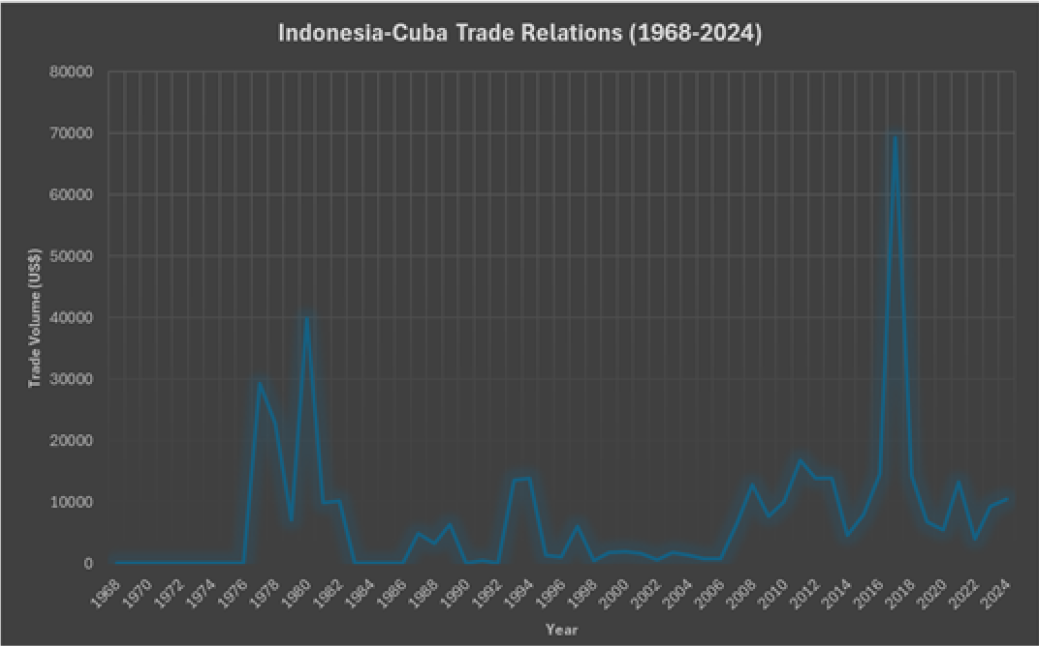
During President Soekarno administration, the bilateral relations were excepcionally warm and cordial, and but mainly emphasized on political relations and to a lesser extent socio-cultural cooperation. But, during the President Soeharto administration, politically, Indonesia did not have close relationship with the Cuban leaders. At the earlier phase of the New Order regime, Soeharto put forward the state-led development agenda, thus, it’s foreign policy must be in conjunction with the national development. In the economic realm, the Latin American and Caribbean nations were not considered as potential to support the Indonesian economic development due to the geographical distance, product similarities, and due to status as developing third world nations and donor recipient countries. But interestingly, during the late 1970s until 1982, the bilateral trade relations were rising significantly, reaching US$39.9 million in 1980, in which Indonesia imported Manuf. of leather or of artif. or reconst. leather (SITC612) amounted US$3990544.
Indonesia – Cuba relations from the 1990s to 2019 are best understood as steady and ideationally compatible rooted in Indonesia’s free and active foreign policy and Cuba’s long-standing emphasis on South-South solidarity, including through various multilateral fora. In 1995, Indonesia re-activated its direct diplomatic footprint in Cuba: the Presidential Decree No.43/1995 mandated the reopening of the Embassy of Indonesia in Havana after earlier closure period. In the 2000s, two countries showed a multilateral alignment, especially on issues of sovereignty, when in 27 November 2001, Indonesia is listed among states voting “in favor” of ending the US embargo against Cuba (United Nations Office of the High Commissioner, 2001). High-level engagement also appeared via NAM (Non-Aligned Movement) when President Susilo Bambang Yudhoyono visited Havana to attend the 14th NAM Summit (Liputan6, 2006). In 2007, Indonesia and Cuba explored a more practical cooperation in public health when two countries’ health ministries seek to develop a joint research in developing new vaccines for diseases such as dengue and malaria. During the early to mid 2010s, cooperation became more sectoral and technical, with sports diplomacy standing out. Indonesia’s Ministry of Youth and Sports agreed a sport cooperation MoU signed in 2013 (JDIH Kemenpora) with Cuba’s relevant sports authority, framing cooperation through exchanges of expertise and structured programs. In 2017, the two countries renewed their cooperation on health by signing a MoU, discussed and endorsed on the sidelines of the 70th World Health Assembly in Geneva, with cooperation in areas such as vaccines, maternal and child health, communicable and non-communicable diseases, joint R&D (biopharma/biotech/nanotech), and human resources and knowledge transfer (Kementerian Kesehatan Republik Indonesia, 2017).
In the political sphere, over the years both countries have demonstrated strong cooperation through mutual support in various international fora and high-level official visits including the Indonesian presidents, Abdurrahman Wahid and Susilo Bambang Yudhoyono visited Cuba for the High Level Conferences (Summit) on South-South Cooperation (2000), Group-77 summit (2000), and NAM summit (2006). Both nations are members of the Non-Aligned Movement, Group of 77 (G-77), the Forum of East Asia-Latin America Cooperation (FEALAC). Cuba as an associate member of BRICS, and over the years, both countries have shown strong cooperation through mutual support in international fora to advance the South-South cooperation agenda.
Cuba views Indonesia as one of its main partners in fostering a common stance to promote the third world countries’ interests. Cuba has always been committed to support the integrity of the Republic of Indonesia (NKRI), and sees Indonesia as a supportive partner for the lifting of the economic, trade, and financial embargo by the United States, partner for trade and investment cooperation, and as a hub for Cuban products in the Southeast Asian region. Further, in 2014, the Cuban government appointed Ambassador accredited to the Association of Southeast Asian Nations (ASEAN), and subsequently, in 2020, Cuba acceded to the Treaty of Amity and Cooperation (TAC) demonstrating its commitment to regional peace and stability, and the promotion of friendly relations and cooperation with ASEAN (ASEAN Secretariat, 2024). Further, the ASEAN Committee in Havana, Cuba (ACHC) was established in 2022 to promote ASEAN’s relations and cooperation with Cuba in the host country.
Meanwhile, Indonesia views Cuba as an important partner supporting the Unitary State of the Republic of Indonesia (NKRI) and mutual support in international fora, strengthening trade and investment cooperation, technical cooperation, health, and education cooperation. Both countries have signed agreements, namely, Exchange of Notes between the Government of the Republic of Indonesia and the Government of the Republic of Cuba on the Establishment of a Joint Commission (1996), and Memorandum of Understanding between the Government of the Republic of Indonesia and the Government of the Republic of Cuba on the Establishment of Bilateral Consultation (1997). Further, both countries have held five times Joint Commission Meeting (1997, 2000, 2003, 2005, 2008) and twice held Bilateral Consultation Meeting (2016, 2022).
In the economic sphere, during the period 1968-2024, the bilateral trade relations had shown an increasing trends over the years but with fluctuations. During the late 1970s until 1982, the bilateral trade showed significant improvement reaching US$39.9 million in 1980. After that, the bilateral trade remains limited until late 2000s, and reaching its peak amounted US$69.3 million in 2017 (see graph 1). In 2017, Indonesian main exports to Cuba were papers and soaps reaching US$8 million, meanwhile Indonesia mainly imported raw cane sugar valued US$59.47 million, followed by Cathode ray television picture tubes, incl. video monitor cathode ray tubes amounted US$521664, and Antisera and other blood fractions amounted US$410046. During the pandemic Covid-19 period (2019-2020), like in many countries throughout the globe, the bilateral economic relations between Indonesia and Cuba faced a decline. During this period, in 2019 the bilateral trade relations amounted US$6.7 million, and in 2020 the total trade relations further declined to US$5.5 million.
In 2024 the bilateral trade relations amounted US$10.5 million, in which Indonesia recorded a trade surplus amounted US$8.4 million. Indonesian export to Cuba valued at US$9.4 million, while Indonesian import from Cuba amounted to US$1.1 million (Trade Map, 2025). Indonesia’s main exports2 to Cuba are: Soap in the form of flakes, granules, powder, paste or in aqueous solution (HS340120) valued at US$7.97 million, followed by Palm oil and its fractions, whether or not refined (excl. chemically modified and crude) (HS151190) valued at US$437000, Vaccines for human medicine (HS300241) valued at US$264000, Soap and organic surface-active products and preparations, in the form of bars, cakes, moulded.. (HS340111) valued at US$231000, and Sacks and bags, for the packing of goods, of polyethylene or polypropylene strip or the like (HS630533) valued at US$164000. These commodities accounted for 96.2% of the total Indonesian export to Cuba in 2024.
Meanwhile, Indonesian main imports from Cuba are: Cigarettes, containing tobacco (HS240220) valued at US$488000, Immunological products, put up in measured doses or in forms or packings for retail sale (excl.) (HS300215) valued at US$230000, Cigars, cheroots, cigarillos and cigarettes consisting wholly of tobacco substitutes (HS240290) valued at US$207000, Cigars, cheroots and cigarillos containing tobacco (HS240210) valued at US$69000, Whole raw hides and skins of bovine "incl. buffalo" or equine animals, whether or not dehaired (HS410150) valued at US$23000, Butts, bends, bellies and split raw hides and skins of bovine "incl. buffalo" or equine animals (HS410190) valued at US$19000, and Rum and other spirits obtained by distilling fermented sugar-cane products (HS220840) valued at US$9000.
Graph 1: Indonesia-Cuba Trade Relations Period 1968-2024
- Source: World Integrated Trade Solutions (2025)
In addition to trade relations, there are various Indonesian investments in Cuba in the hospitality sector. There are six Indonesian investment in hotel management network (Archipelago International) in Cuba, namely: Grand Aston Cayo, Las Brujas Beach Resort and Spa, Aston Costa Verde Beach Resort, Aston Panorama Hotel, Grand Aston Varadero Beach Resort, Grand Aston Cayo Paredon Beach Resort, and Grand Aston La Habana Hotel (KBRI Havana, 2025). Meanwhile during the period 2010-2025, there is none Cuban investment in Indonesia (Satu Data BKPM, 2025). In the tourism sector, in 2024, it is recorded there are 495 Cuban visitors visited Indonesia, and during the period January-October 2025 there are 262 Cuban visitors came to Indonesia. These figures are significantly higher compared during the Covid-19 pandemic period which recorded 171 visitors (2020) and 20 visitors (2021) (Badan Pusat Statistik, 2025). Meanwhile, for the technical cooperation, over the years Indonesia offered capacity building program including coconut product diversification training (2024).
Also, to strengthen the bilateral economic relations, both countries have signed economic agreements, namely, Agreement on Economic and Trade Cooperation (1992), Agreement on the Promotion and Protection of Investments (1997), Memorandum of Understanding on Sugar Cane Cooperation (2006), Memorandum of Understanding on the Establishment of A Framework for the Development of Business Relations (2008), Renewed Memorandum of Understanding on Sugar Cane Cooperation (2015), and Letter of Intent on Technical Cooperation (2024). But there are clearly challenges in strengthening Indonesia-Cuba bilateral economic relations, including due to the unilateral U.S. comprehensive economic embargo (economic, commercial, and financial blockade) on Cuba since 1962 which remains in place until today (also so-called U.S economic warfare against Cuba), U.S. list of countries as State Sponsors of Terrorism (Cuba, North Korea, Iran, and Syria), geographical distance, and high transportation cost.
In the socio-cultural sphere, to promote people to people contact, both countries signed Agreement on Visa Exemptions for Holders of Diplomatic and Official or Service Passports which entered into force as of 31 January 2023. Indonesia and Cuba socio-cultural cooperation mainly focused on sports, health, education, and research sectors. Both countries sent trainers and athletes, conducted health research cooperation such as developing vaccines for dengue fever and malaria, and as well as educational cooperation in higher educational institutions and schools. As a form of friendship, there are two Indonesian schools in Cuba, namely, Instituto Preuniversitario Urbano República de Indonesia (Guanajay, Artemisa Province), and Escuela Primero de La República de Indonesia di Marti (Marti, Matanzas Province). The Cuban government provided scholarships medical studies to 9 Indonesian citizens at the Escuela Latinoamericana de Medicina (ELAM), Cuba, and the Indonesian government has also actively promote educational and cultural diplomacy among others through the Darmasiswa and Kemitraan Negara Berkembang (KNB) scholarship programs as well as Joint Development Post Doctoral Degree and Professional Doctor offered by National Research and Innovation Agency (BRIN). However, at present, the exact number of Cuban students who have received those instruments appears not publicly consolidated in accessible official reporting.
Further, both countries have also signed agreements, namely, Agreement of Cultural Cooperation (1960), Agreement (Renewed) on Cultural Cooperation (1997), Memorandum of Understanding on Sports Cooperation (2003), Memorandum of Understanding between the Department of Foreign Affairs of the Republic of Indonesia and the Ministry of Foreign Relations of the Republic of Cuba on Education and Training Cooperation (2003), Arrangement on Sports Cooperation (2007), Letter of Intent between the Minister of Health of the Republic of Indonesia and the Minister of Health of the Republic of Cuba (2007), Renewed Agreement on Cultural Cooperation (2013), Renewed Memorandum of Understanding on Sports Cooperation (2013), Memorandum of Understanding on Health Cooperation (2017), Memorandum of Understanding on Science, Technology and Innovation Cooperation (2024), and Memorandum of Understanding on Health Cooperation (2025).
Meanwhile for the people-to-people relations, although the number is still relatively small, it is recorded there are some Indonesian citizens living in Cuba among others serving as pastors and expatriates at the hospitality sector, and Cuban citizens living in Indonesia among others as athletes (volleyeball). Also, during the tsunami in Aceh in 2004, Cuba as part of international humanitarian and medical diplomacy efforts sent 35 doctors and medicines and during the earthquake in Yogyakarta in 2006, Cuba sent 135 doctors and medical personnel (Luska, 2025).
Potential Opportunities for Broader Economic and Socio-Cultural Cooperation between Indonesia and Cuba
The two countries are old friends with historically rooted political solidarity and South–South cooperation ethos, and thus, elevating bilateral partnership can be articulated as a strategic deepening of the two countries’ moving towards a comprehensive partnership for shared prosperity. Under President Prabowo Subianto's administration, it is emphasized that Indonesian diplomacy will continue to be directed to support the Long-Term Plan 2025-2045 Indonesian Golden Vision (Sekretariat RPJPN 2025-2045, 2025). The Prabowo administration aims to achieve the Asta Cita grand vision by upholding the values of Pancasila and the principle of free and active foreign policy. The National Medium-Term Development Plan (RPJMN) 2025-2029 serves as a detailed articulation of the President’s vision, mission, and priorities, collectively known as Asta Cita. By nature, Indonesia currently prioritizes export diversification, outward-looking investment, industrial upgrading, and the expansion of non-traditional markets in support of its long-term development vision (Golden Indonesia 2045).
As economic diplomacy become the priority for Indonesia, a bilateral preferential framework or a phased pathway towards Indonesia–Cuba Comprehensive Economic Partnership Agreement (CEPA) could be a strategic avenue worth undertaken to elevate both countries’ partnership for shared prosperity. Indonesia itself to date has at least 46 trade initiatives (PTA, FTA, and CEPA) which are currently in the process of studies, negotiations or have entered into force (Asia Regional Integration Center, 2025). With the Latin American and Caribbean counterparts, among others there are Indonesia-Chile CEPA (entered into force in 2019), Indonesia-Peru CEPA (signed 2025), and Indonesia-Mercosur CEPA (proposed/under consultation). These success stories can be a reference to realize the Indonesia-Cuba CEPA.
Meanwhile, Cuban foreign policy towards the Asia Pacific region (including Southeast Asian region) have been characterized on the confluence of interests and support the Global South nations, and the systematic search of spaces for economic cooperation (Panton León, 2025). Indonesia is viewed as an emerging Southeast Asian nation titan and the country has made decisive progress towards integration within the emerging multipolar system. Cuba’s economic diplomacy encompasses on internationalist practices, sovereign trade, mutual benefit, and free from political inteference (Gillies-Lekakis, 2025). Cuba-Indonesia bilateral economic relation adheres these values and principles. Cuba has several trade initiatives including the Caribbean Community (CARICOM)-Cuba Trade and Economic Cooperation Agreement3 (signed in 2000), MERCOSUR-Cuba FTA, and Colombia-Cuba Economic Agreement to strengthen commercial and economic ties. Further, Cuba’s economic diplomacy seeks economic resilience, technology access, and productive partnerships to overcome structural constraints and the enduring unilateral U.S. embargo4.
Therefore, both countries view economic diplomacy as a priority within the foreign policy agenda, thus, establishing trade agreements are crucial for both countries to support enhancing national welfare. Indonesia-Cuba CEPA could be a potential common interest to strengthen bilateral economic relations as part of their economic diplomacy efforts. For Indonesia, Cuba could be a potential gateway to enter the Carribean market. To support the economic cooperation, a financial cooperation between the two countries’ central banks—particularly through Local Currency Settlement (LCS) arrangements and the gradual integration of Quick Response Code Indonesia Standard (QRIS)-based digital payment systems—would further strengthen economic ties by reducing transaction costs, mitigating third-currency dependence, and enhancing trade continuity under external financial pressures (e.g. U.S. sanction on Cuba).
Crucially, broader cooperation should rest on a stronger knowledge base and mutual understanding, which can be achieved by systematically expanding exchanges of researchers, policy experts, academics, technocrats, and practitioners across priority sectors. Structured programs for joint research, visiting fellowships, post-doctoral placements, and expert secondments—especially under the framework of BRIN cooperation and existing education and training MoUs—would allow both countries to better understand each other’s economic structures, regulatory environments, and development challenges. Such exchanges are particularly relevant in agriculture (notably sugar-cane and agro-industry), public health and biotechnology, food security, renewable energy, and industrial policy, where applied knowledge can directly inform economic cooperation and investment decisions.
Both Ministry of Foreign Affairs have signed Memorandum of Understanding on Education and Training Cooperation (2003), and this can be follow up by exchange of Spanish and Indonesian language instructors teaching at the diplomatic academies, as well as higher educational institutions, for instance, at Universitas Prof. Dr. Moestopo (Beragama) which has a Center for Latin America (CeLA) for teaching Spanish language, meanwhile at Universidad de la Habana for the Indonesian language. Further, Indonesia could explore to establish Indonesian Corner or Indonesia Study Center at higher educational institutions and public libraries in Cuba, as well as promoting cooperation Indonesian schools in Cuba with the schools in Indonesia to promote socio-cultural cooperation, including language and curriculum programs.
Last but not least, Indonesia could share best practices on Indonesian economic school of thought including ‘ekonomi kerakyatan’ (common people’s economy) and ‘berdikari5 (berdiri di atas kaki sendiri” or to stand on one's own feet) in guiding economic processes in Cuba, which will contribute to the effective implementation of the National Economic and Social Development Plan 2030 in Cuba. Currently, among others Cuba has exchange of experiences with Vietnam and Laos in guiding economic processes in Cuba (Panton León, 2025). To this end, it will be necessary to conduct more systematic theoretical seminars between the Communist Party of Cuba with the relevant stakeholders in Indonesia. Haridadi Sudjono, a former Indonesian Ambassador to Cuba, stated that Indonesian first president, Soekarno's teachings (paradigms) became Fidel Castro's reference in leading his country (Al Ghifari, 2012). The two of Soekarno's ideas that Fidel Castro most inspired were Tri-Sakti and Resopim. The Tri-Sakti concept encompasses three things: political sovereignty, economic self-reliance, and cultural personality. Meanwhile Resopim, is the essence of Soekarno's speech in 17th August 1961: Revolution, Indonesian Socialism, and National Leadership.
Indonesia-Cuba Bilateral Free Trade Scenario: A Partial Equilibrium Analysis
In this section, the paper attempts to analyze the potential impact of the Indonesia-Cuba bilateral free trade scenario using the TINA model. The objective is to analyze the potential impact on the trade creation effects. To analyze the bilateral FTA scenario, the paper uses the HS 6 Digits Code and a complete tariff dismantlement scenario (extreme scenario) on all products using the trade data in 2024
The bilateral free trade TINA simulation reveals trade creation for Indonesia (increased in Indonesian export to Cuba) amounted US$1.11 million, an increase of 12.08% (by trade value) of imports of selected commodities by Cuba from Indonesia. There are 23 commodities impacted and 0 commodities not impacted (for example, as a result of inelastic demand). On the other hand, the study also shows trade creation for Cuba (increased in Cuban export to Indonesia) amounted US$815650, an increase of 104.98% (by trade value) of imports of selected commodities by Indonesia from Cuba, representing an increase of 77.53% in total imports of Indonesia from Cuba in 2024. There are 12 commodities impacted, and 0 (none) commodity not impacted.
The Potential Impact of Indonesia-Cuba Bilateral Free Trade Scenario on the Trade Creation Effect
The bilateral free trade utilizing TINA simulation revealed Indonesian trade creation effect or meaning the tariff dismantlement opens market access for Indonesian export to Cuba amounted US$1.11 million including soap, palm oil, food preparations, insulated electric conductors, sacks and bags, acids, essential oil, cases and containers, and plastics; tubes, pipes and hoses thereof, furnitures, ceramics, seats, mattresses, glass, curtains, clothing accessories, and garments (the results are reported in table 7).
The top 6 Indonesian potential export products to Cuba are: Soap; in forms n.e.c. in item no. 3401.11 (HS340120) which contributed the highest potential increase of Indonesian export to Cuba by US$729303, followed by Vegetable oils; palm oil and its fractions, other than crude, whether or not refined, but not chemically modified (HS151190) amounted to US$109095; Food preparations; bakers' wares n.e.c. in heading no. 1605, whether or not containing cocoa; communion wafers, empty cachets suitable for pharmaceutical use, sealing wafers, rice papers and similar products (HS190590) valued at US$90866; Insulated electric conductors; for a voltage not exceeding 1000 volts, not fitted with connectors (HS854449) valued at US$74794; Sacks and bags; of a kind used for the packing of goods, of man-made textile materials, of polyethylene or polypropylene strip or the like, not flexible intermediate bulk containers (HS630533) valued at US$39923; and Soap and organic surface-active products; in the form of bars, cakes, moulded shapes, and paper, wadding, felt and nonwovens, impregnated, coated or covered with soap or detergent, for toilet use (including medicated products) (HS340111) valued US$35355. These top 6 export potential products represent 97.23% of the total trade creation effect.
Meanwhile, on the other hand the tariff dismantlement would open Cuba’s export to Indonesia amounted to US$815650 with main potential products including: Cigarettes; containing tobacco (HS240220) valued at US$504674; Cigars, cigarillos and cheroots; containing tobacco substitutes including the weight of every band, wrapper or attachment thereto (HS240290) valued at US$243528; Cigars, cheroots and cigarillos; containing tobacco including the weight of every band, wrapper or attachment thereto (HS240210) valued at US$55038; and Rum and other spirits obtained by distilling fermented sugar-cane products (HS220840) valued at US$11453. The top 4 commodities represent 99.88% of the total creation effect (The results are reported in table 8).
Table 7: The Potential Impact of RI-CUBA FTA Scenario on Indonesia’s Export to Cuba (Trade Creation Effects) (All Products)
Product Code |
Commodity Description |
Trade Creation Effects in USD |
340120 |
Soap; in forms n.e.c. in item no. 3401.11 |
729303.17 |
151190 |
Vegetable oils; palm oil and its fractions, other than crude, whether or not refined, but not chemically modified |
109095.98 |
190590 |
Food preparations; bakers' wares n.e.c. in heading no. 1605, whether or not containing cocoa; communion wafers, empty cachets suitable for pharmaceutical use, sealing wafers, rice papers and similar products |
90866.75 |
854449 |
Insulated electric conductors; for a voltage not exceeding 1000 volts, not fitted with connectors |
74794.01 |
630533 |
Sacks and bags; of a kind used for the packing of goods, of man-made textile materials, of polyethylene or polypropylene strip or the like, not flexible intermediate bulk containers |
39923.30 |
340111 |
Soap and organic surface-active products; in the form of bars, cakes, moulded shapes, and paper, wadding, felt and nonwovens, impregnated, coated or covered with soap or detergent, for toilet use (including medicated products) |
35355.82 |
291570 |
Acids; saturated acyclic monocarboxylic acids; palmitic acid, stearic acid, their salts and esters |
6380.59 |
330129 |
Oils, essential; n.e.c. in heading no. 3301 (terpeneless or not), including concretes and absolutes |
4603.99 |
420292 |
Cases and containers; n.e.c. in heading 4202, with outer surface of plastic sheeting or of textile materials |
3551.23 |
391732 |
Plastics; tubes, pipes and hoses thereof, other than those of item no. 3917.31, not reinforced or otherwise combined with other materials, without fittings |
2241.00 |
940171 |
Seats; with metal frames, upholstered, (excluding medical, surgical, dental, veterinary or barber furniture) |
1954.24 |
691390 |
Ceramic statuettes and other ornamental ceramic articles; other than of porcelain or china |
1332.87 |
940360 |
Furniture; wooden, other than for office, kitchen or bedroom use |
1207.67 |
940490 |
Bedding and similar furnishing articles; n.e.c. in heading no. 9404 (e.g. quilts, eiderdowns, cushions, pouffes and pillows) |
1191.62 |
940169 |
Seats; with wooden frames, not upholstered, (excluding medical, surgical, dental, veterinary or barber furniture) |
1187.29 |
940350 |
Furniture; wooden, for bedroom use |
1047.70 |
940421 |
Mattresses; of cellular rubber or plastics, whether or not covered |
746.97 |
940320 |
Furniture; metal, other than for office use |
443.19 |
702000 |
Glass; articles n.e.c. in chapter 70 |
316.42 |
630319 |
Curtains (including drapes) and interior blinds; curtain or bed valances, knitted or crocheted, of textile materials other than synthetic fibres |
291.74 |
621710 |
Clothing accessories; other than those of heading no. 6212 (not knitted or crocheted) |
193.69 |
611120 |
Garments and clothing accessories; babies', of cotton, knitted or crocheted |
110.29 |
441400 |
Wooden frames; for paintings, photographs, mirrors or similar objects |
39.39 |
- Source: Authors Modification from TINA (2025)
CONCLUSIONS
Indonesia and Cuba are old two friends and have cordial diplomatic relations, but their economic cooperation—particularly in trade and investment—remains below their potentialities. This study aims to identify the potential trade and investment opportunities using the RCA-CMSA Product Classification Model and TINA Model. In the trade sphere, the RCA-CMSA Model revealed targeted trade collaboration opportunities, in which Indonesia is suggested to export the iron and steel products (ferro-alloys (HS7202), flat-rolled products of stainless steel (HS7219), and stainless steel in ingots or other primary forms (HS7218)); nickel mattes, nickel oxide sinters and other intermediate products of nickel metallurgy (HS7501); mineral commodities (HS25-HS26), namely, copper ores and concentrates (HS2603); natural or cultured pearls, precious or semi-precious stones, precious metals, metals clad (HS71), namely, Articles of jewellery and parts thereof, of precious metal or of metal clad with precious metal (HS7113); wood (HS47-48), namely, chemical wood pulp, soda or sulphate (excl. dissolving grades) (HS4703) and uncoated paper and paperboard, of a kind used for writing, printing or other graphic purposes, ... (HS4802); machinery and electrical equipment (HS84-HS85), namely, Telephone sets, incl. smartphones and other telephones for cellular networks or for other wireless (HS8517), and coconut "copra", palm kernel or babassu oil and fractions thereof, whether or not refined (HS1513).
Table 8: The Potential Impact of RI-CUBA FTA Scenario on Cuba’s Export to Indonesia (Trade Creation Effects) (All Products)
Product Code |
Commodity Description |
Trade Creation Effects in USD |
240220 |
Cigarettes; containing tobacco |
504674.96 |
240290 |
Cigars, cigarillos and cheroots; containing tobacco substitutes including the weight of every band, wrapper or attachment thereto |
243528.05 |
240210 |
Cigars, cheroots and cigarillos; containing tobacco including the weight of every band, wrapper or attachment thereto |
55038.66 |
220840 |
Rum and other spirits obtained by distilling fermented sugar-cane products |
11453.87 |
220870 |
Liqueurs and cordials |
438.74 |
854890 |
Electrical parts of machinery or apparatus; n.e.c. in chapter 85 |
335.72 |
910121 |
Wrist-watches; (not electrically operated), automatic winding, whether or not incorporating a stop-watch facility, case of precious metal or of metal clad with precious metal |
58.10 |
490890 |
Printed matter; transfers (decalcomanias), other than vitrifiable |
42.23 |
220421 |
Wine; still, in containers holding 2 litres or less |
29.33 |
420291 |
Cases and containers; n.e.c. in heading 4202, with outer surface of leather or of composition leather |
26.46 |
853620 |
Electrical apparatus; automatic circuit breakers, for a voltage not exceeding 1000 volts |
24.62 |
841391 |
Pumps; parts thereof |
3.87 |
- Source: Authors Modification from TINA (2025)
Meanwhile Cuba should export machineries and electrical equipments (HS84-HS85) including Automatic data-processing machines and units thereof; magnetic or optical readers, machines (HS8471), Machines and mechanical appliances having individual functions, not specified or included elsewhere (HS8479), Machinery, plant or laboratory equipment whether or not electrically heated (excl. furnaces) (HS8419), Parts suitable for use solely or principally with the machinery of heading 8425 to 8430, n.e.s. (HS8431), and Insulated "incl. enamelled or anodised" wire, cable "incl. coaxial cable" and other insulated (HS8544); Transportation products (HS86-HS89) such as Parts and accessories for tractors, motor vehicles for the transport of ten or more persons (HS8708) and Motor cars and other motor vehicles principally designed for the transport of (HS8703). Other commodities are: Gold, incl. gold plated with platinum, unwrought or not further worked than semi-manufactured (HS7108), Cane or beet sugar and chemically pure sucrose, in solid form (HS1701), and Iron ores and concentrates, incl. roasted iron pyrites (HS2601). Historically, sugar was vital to Cuba’s national economy, thus, the study suggests Indonesia should strategically import Cane or beet sugar and chemically pure sucrose, in solid form (HS1701), but later Indonesia could also explore for outbound investment and technical cooperation in the Cuban sugar industry. Sugar cane cooperation could be strategic to stengthen Indonesia-Cuba diplomatic relations.
In the investment sphere, the findings suggest Indonesian outbound investment opportunities in Cuba are Human blood; animal blood prepared for therapeutic, prophylactic or diagnostic uses; antisera (HS3002); beverages and spirits, such as Undenatured ethyl alcohol of an alcoholic strength of < 80%; spirits, liqueurs and other spirituous (HS2208); Natural honey (HS0409); and unwrought lead (HS7801). Meanwhile Cuba is suggested to invest in Indonesia in transportation products (HS86-HS89) such as Motorcycles, incl. mopeds, and cycles fitted with an auxiliary motor, with or without side-cars (HS8711) and Bicycles and other cycles, incl. delivery tricycles, not motorised (HS8712); machineries and electrical equipments (HS84-HS85) such as Monitors and projectors, not incorporating television reception apparatus; reception apparatus (HS8528) and Primary cells and primary batteries, electrical; parts thereof (excl. spent) (HS8506); food products such as Bread, pastry, cakes, biscuits and other bakers" wares, whether or not containing cocoa; communion (HS1905), Essential oils, whether or not terpeneless, incl. concretes and absolutes; resinoids; extracted (HS3301), Mattress supports (excl. spring interiors for seats); articles of bedding and similar furnishing (HS9404), New pneumatic tyres, of rubber (HS4011), Jerseys, pullovers, cardigans, waistcoats and similar articles, knitted or crocheted (excl.) (HS6110), and Plywood, veneered panel and similar laminated wood (excl. sheets of compressed wood, cellular (HS4412).
The study also conducted a free trade simulation using TINA model and revealed that Indonesia’s main potential export products to Cuba including soap, palm oil, food preparations, insulated electric conductors, sacks and bags, acids, essential oil, cases and containers, and plastics; tubes, pipes and hoses thereof, furnitures, ceramics, seats, mattresses, glass, curtains, clothing accessories, and garments. Meanwhile for Cuban main potential exports to Indonesia are cigarettes, cigars, cigarillos and cheroots, rum and other spirits.
The findings suggest both countries should explore to establish Indonesia–Cuba Comprehensive Economic Partnership Agreement to expand bilateral economic cooperation, fostering Central Bank financial cooperation via Local Cooperation Settlement (LCS) and Quick Response Code Indonesia Standard (QRIS) digital payment system aimed to reducing transaction costs, mitigating third-currency dependence, and enhancing trade continuity under external financial pressures. Further, these economic cooperation initiatives should be complemented with the encouragement of socio-cultural, education and training, and research cooperation to enhance mutual understanding, and advancing South-South cooperation agenda. In addition, Indonesia could share its best practices on Indonesian economic school of thought including ‘ekonomi kerakyatan’ (common people’s economy) and ‘berdikari (berdiri di atas kaki sendiri” or to stand on one's own feet) in guiding economic processes in Cuba, to contribute to the effective implementation of the National Economic and Social Development Plan 2030 in Cuba.
notes
1 There are other partial-equilibrium model dashboards (Dashboards for Trade Policy Diagnostics): SMART model (Single Market Simulation Model), Global Simulation Analysis of Industry-Level Trade Policy (GSIM), Tariff Reform Impact Simulation Tool (TRIST), Agricultural Trade Policy Simulation Model (ATPSM), and TRADESIFT (United Nations Trade and Development, 2025) and (de Melo, 2020).
2 Using the HS 8 Digit Codes: soap chips (HS34012020), liquid fractions of palm oil, refined oil, but not chemically modified, in packing of a net… (HS15119036), pertussis, measles, meningitis or polio vaccines (HS30024120), vaccines for human medicine other than tetanus toxoid, pertussis, measles, meningitis or polio (HS30024190), soap for toilet use including bath soap other than medicated soap (HS34011150), and sacks and bags, of a kind used for the packing of goods; of polyethylene or polypropylene strip (HS63053390).
3 The Agreement allows for the reciprocal preferential trade in goods between the CARICOM MDCs of Barbados, Guyana, Jamaica, Suriname and Trinidad and Tobago and Cuba. The Least Developed Countries of CARICOM are not required to engage in the liberalisation effort.
4 The unilateral U.S. comprehensive economic embargo (economic, commercial, and financial blockade) on Cuba since 1962 which remains in place until today (also so-called U.S economic warfare against Cuba), U.S. list of countries as State Sponsors of Terrorism (Cuba, North Korea, Iran, and Syria).
5 Indonesian first president, Soekarno's teachings (paradigms), namely, Tri-Sakti (political sovereignty, economic self-reliance, and cultural personality) and Resopim (Revolution, Indonesian Socialism, and National Leadership) became Fidel Castro's reference in leading his country.
BIBLIOGRAPHIC REFERENCES
Air Mancur. (n.d.). Tentang kami. Air Mancur. Retrieved from: https://www.airmancur.co.id/about.html?
Al Ghifari, K. (2012). Mengapa Ajaran Bung Karno Kurang Berkembang?. Berdikarionline. 28 October. Retrieved from: https://www.berdikarionline.com/mengapa-ajaran-soekarno-tidak-berkembang/
Al-Husin, R. N., & Virgianita, A. (2024). “Mapping the Literature on the Relationship between Indonesia and Chile as Non-Traditional Partners”. Journal La Sociale, 5(2), 458-470. Retrieved from: https://newinera.com/index.php/JournalLaSociale/article/view/1131
ASEAN Secretariat (2024). Ambassador of Cuba to ASEAN presents Letter of Credence to the Secretary-General of ASEAN. 12 September. ASEAN Secretariat Website. Retrieved from: https://asean.org/ambassador-of-cuba-to-asean-presents-letter-of-credence-to-the-secretary-general-of-asean/
Asia Regional Integration Center. (2025). FTA Status by Economy. Asian Development Bank. Retrieved from: https://aric.adb.org/database/fta
Badan Pusat Statistik. (2025). Jumlah Kunjungan Wisatawan Mancanegara per bulan Menurut Kebangsaan (Kunjungan). Retrieved from: https://www.bps.go.id/id/statistics-table/2/MTQ3MCMy/jumlah-kunjungan-wisatawan-mancanegara-per-bulan-menurut-kebangsaan--kunjungan-.html
Balassa, B. (1965). Trade Liberalisation and “Revealed” Comparative Advantage. The Manchester School, 33(2), 99–123. Retrieved from: https://doi.org/10.1111/j.1467-9957.1965.tb00050.x
Biofarma. (2023). Laporan tahunan: Annual report. Biofarma. Retrieved from: https://www.biofarma.co.id/en/annual-report/download/a120e7c99351ece419f511627d4d9678
Center of Policy Strategy for Special Issues and Data Analysis (2025). Buku Pedoman Economic Intelligence: RCA-CMSA Product Classification Model. Kementerian Luar Negeri Republik Indonesia.
De Melo, J. (2020). “A Dashboard for Trade Policy Diagnostics”, Working Paper Development Policies, No. 275, October, Fondation pour les Études et Recherches sur le Développement international. Retrieved from: https://ferdi.fr/dl/df-9qeugDRDiw34ZoCPP6PdA8mZ/ferdi-p275-a-dashboard-for-trade-policy-diagnostics.pdf
Departemen Luar Negeri Republik Indonesia. (1971). Dua Puluh Lima Tahun Departemen Luar Negeri 1945-1970. Ofsett KAWAL. 1st Edition. August, Jakarta.
Diphda, B.C., Elnathan, A., Arianto, D.P., Muhammad, N., & Hafizh, S.B. (2025). “Analyzing the Underlying Factors of Indonesia's Decision to Sign the Indonesia-Peru Comprehensive Economic Partnership Agreement (IP-CEPA)”. CITIZEN: Jurnal Ilmiah Multidisiplin Indonesia, Vol 5, No. 6, 2025. Retrieved from: https://journal.das-institute.com/index.php/citizen-journal/article/view/1058
Drummond, G., Ensor, J., Ashford, R. (2008) Strategic marketing: planning and control, 3rd ed., Oxford: Elsevier Ltd.
Firdaus, A.H., & Nurhayati, E. (2020). “Optimalisasi Pemanfaatan Preferential Trade Agreement Indonesia – Peru”, INDEF Working Paper, No.6/2020, Institute for Development of Economics and Finance, Jakarta. Retrieved from: https://indef.or.id/publikasi/optimalisasi-pemanfaatan-preferential-trade-agreement-indonesia-peru/
Gillies-Lekakis, S. (2025). Fortalecimiento de los vínculos en el Asia-Pacífico: La Estrategia de Diversificación de Cuba con Indonesia y Australia. Política Internacional, VII (Nro. 3), 214-222. Retrieved from: https://doi.org/10.5281/zenodo.15758868
JDIH Kemenpora. (n.d.). Naskah kerjasama: Memorandum saling pengertian antara kementerian pemuda dan olahraga Republik Indonesia dan Institut Olahraga, Pendidikan dan Jasmani dan Rekreasi nasional Republik Kuba tentang kerjasama olahraga. Kementerian Pemuda dan Olahraga. Retrieved from: https://jdih.kemenpora.go.id/mou/detail/3/16/memorandum-saling-pengertian-antara-kementerian-pemuda-dan-olahraga-republik-indonesia-dan-institut-olahraga-pendidikan-jasmani-dan-rekreasi-nasional-republik-kuba-tentang-kerjasama-olahraga.html
KBRI Havana. (2025). Memorandum Akhir Jabatan Dubes RI KBRI Havana Des 2020 – Feb 2025. Retrieved from: https://www.kemlu.go.id/havana/publikasi/akip-kbri-havana/memorandum-akhir-jabatan-dubes-ri-kbri-havana-des-2020---feb-2025-
Kementerian Kesehatan Republik Indonesia. (2017, May 25). Menkes Ri dan Kuba tandatangani mou bidang kesehatan. Kementerian Kesehatan. Retrieved from: https://kemkes.go.id/id/menkes-ri-dan-kuba-tandatangani-mou-bidang-kesehatan
Kimia Farma. (2022). Standing firm, spearheading the future healthcare. Laporan Tahunan Kimia Farma. Retrieved from: https://www.kimiafarma.co.id/en/annual-report
Kurniawan, H. (2024). “The Revival of Trade Agreement between Indonesia and Sudan: An Analytical Approach”. Dissertation, December, Swiss School of Business and Management, Geneva.
Liputan6. (2006). Presiden Yudhoyono tiba di Havana, 15 September, Liputan6. https://www.liputan6.com/global/read/129230/presiden-yudhoyono-tiba-di-havana#:~:text=Presiden%20Susilo%20Bambang%20Yudhoyono%20telah%20tiba%20di,pertemuan%20puncak%20Konferensi%20Tingkat%20Tinggi%20Gerakan%20Nonblok.
Luska. (2025). “KBRI Havana Rayakan Hubungan Diplomatik Indonesia-Kuba ke 65 di Universitas Havana”, 25th January. Retrieved from: https://indonews.id/artikel/341748/KBRI-Havana-Rayakan-Hubungan-Diplomatik-Indonesia-Kuba-ke-65-di-Universitas-Havana/
National Research and Innovation Agency (BRIN) & Ministry of Foreign Affairs of the Republic of Indonesia (2025), “Policy Paper 2025: Strategi Peningkatan Kerjasama Perdagangan dan Investasi Indonesia di Pasar Nontradisional: Studi Kasus Nigeria dan Chile, Jakarta.
Panton León, A. (2025). Cuban foreign policy toward Southeast Asia: opportunities and threats in the current context. International Politics, VII (No. 2), 86-94. https://doi.org/10.5281/ zenodo.15103770
Perez-Lopez. (n.d.). The Cuban sugar industry 1959-2019: From front-runner to back of the pack. Association for the Study of the Cuban Economy. https://www.ascecubadatabase.org/wp-content/uploads/2020/01/v29 asce_2019_30perezlopez.pdf
Ragimun, Mutaqin, Nurhidayat. R., Yasin, A. (2022). “Indonesia-China Trade Performance in the RCEP Forum”, Journal of Economics and Behavioral Studies, Vol. 14, No. 3, pp. 33-41, September. Retrieved from: https://ojs.amhinternational.com/index.php/jebs/article/view/3306
Rashid, H. (2025). Bangladesh’s transition from the least developed country; Navigating export challenges in a new era. Available at SSRN: https://dx.doi.org/10.2139/ssrn.5345598
Ristanto, D. (2024). “Indonesia’s Potential Trade Flow to EAEU Countries: The Gravity Model Approach”, Jambura Equilibrium Journal, Vol. 6, Issue 2, July. Retrieved from: https://ejurnal.ung.ac.id/index.php/equij/article/view/24981
Rubiolo, M.F. (2014). “Argentina-Indonesia: Fortalecimiento de las Relaciones Comerciales y Despertar del Interés Político en el Marco de Una Estrategia Sur-Sur”, Revista Ad-Minister, No.24, Enero-Junio 2014, pp. 33-51, Universidad EAFIT, Medellín. Retrieved from: https://ideas.repec.org/a/col/000475/011572.html
Rubiolo, M.F., & Ramoneda, E.R. (2012). “Argentina-Indonesia: Creciente Interdependencia Comercial y Revitalización de los Vínculos Políticos (1999-2012)”, Astrolabio: Nueva Época, 9, Centro de Investigaciones y Estudios sobre Cultura y Sociedad, Córdoba. Retrieved from: https://revistas.unc.edu.ar/index.php/astrolabio/article/view/2871
Ruvislei, G. S. (2020). “Cuba – Asia y Oceanía: Relaciones Históricas”, Cuadernos Iberoamericanos, Vol. 8, No. 4, pp. 79-91. Retrieved from: https://www.iberpapers.org/jour/article/view/424?locale=es_ES
Satu Data BKPM. (2025). Perkembangan Realisasi Investasi. Kementerian Investasi dan Hilirisasi/BKPM. Retrieved from: https://data.bkpm.go.id/visualisasi-detail/perkembangan-realisasi-investasi-oLSgf7G
Sekretariat RPJPN 2025-2045. (2025). Rancangan Akhir RPJPN 2025-2045. Retrieved from: https://indonesia2045.go.id/aspirasi.
Sinta, N.R., Sjahril, S.S., & As’adur, M.R. (2026). “Indonesia-Angola Trade and Investment Potential: A Product Classification Model Using Revealed Comparative Advantage and Constant Market Share Analysis”, KAIRÓS Revista de Ciencias Económicas, Jurídicas y Administrativas, Vol. 9, No. 16 (Enero-Junio 2026), Universidad Nacional de Chimborazo, Riobamba, Ecuador. Retrieved from: https://kairos.unach.edu.ec/index.php/kairos/article/view/485
Sjahril, S.S. (2020). “Strengthening Indonesia-Latin America Economic Relations: A Partnership for a Better Future”, External Powers in Latin America
Geopolitics between Neo-extractivism and South-South Cooperation, Routledge pp. 203-218. Available online: https://www.routledge.com/External-Powers-in-Latin-America-Geopolitics-between-Neo-extractivism-and/Gardini/p/book/9780367368593
Sjahril, S.S. (2017) “Faktor-Faktor yang Mempengaruhi Perdagangan Indonesia di Kawasan Amerika Latin”, AGREGAT: Jurnal Ekonomi dan Bisnis, 1(2), September, pp. 187–203. Retrieved from: http://journal.uhamka.ac.id/index.php/agregat/article/view/826/357
Trade Intelligence and Negotiation Adviser. (2025). About TINA. Retrieved from: https://tina.trade/
Trade Map. (2025). Bilateral Trade between Indonesia and Argentina. Retrieved from: https://www.trademap.org/
Tyszynski, H. (1951). World Trade in Manufactured Commodities, 1899–1950. The Manchester School, 19(3), 272–304. Retrieved from https://doi.org/10.1111/j.1467-9957.1951.tb00020.x
United Nations Trade and Development (2025). Chapter 4 : Partial-Equilibrium Trade-Policy Simulation. Retrieved from: https://unctad.org/system/files/official-document/gds2012d2_ch4_en.pdf
UNESCAP. (2025a). User Guide and Explanatory Note for TINA: the Trade Intelligence and Negotiation Adviser. 30 May. Retrieved from: https://www.unescap.org/kp/2025/user-guide-and-explanatory-note-tina-trade-intelligence-and-negotiation-adviser
UNESCAP. (2025b). E-learning Course on Using Trade Intelligence and Negotiation Advisor (TINA). Retrieved from: https://www.unescap.org/our-work/trade-investment-innovation/training/tina
United Nations Office of the High Commissioner. (2001, November 27). Assembly renews call for end to United States embargo against Cuba. United Nations Press Release. Retrieved from: https://www.ohchr.org/en/press-releases/2009/10/assembly-renews-call-end-united-states-embargo-against-cuba
Verico, K. (2020). How to Measure Bilateral Economic Relations? Case of Indonesia–Australia. Institute for Economic and Social Research (LPEM FEB UI).
Verico, K. (2025). Indeks Kerjasama Ekonomi [Presentation]. Pelatihan Pusat Strategi Kebijakan Isu Khusus dan Analisis, bekerja sama dengan LPEM FEB UI.
Verico, K., & Riefky, T. (2022). Bilateral Trade and Investment Relations Analysis: Indonesia and South Korea. International Journal of Business & Society, 23(2).
World Integrated Trade Solutions (2025). Retrieved from: http://wits.worldbank.org/
CONFLICT OF INTEREST
The author declare that there are no conflicts of interest related to this article.
ACKNOWLEDGMENTS
This paper represents the opinion of the authors and is not meant to represent the position or opinion of the official position of any institution members.
The paper is submitted for the XVI International Seminar on International Relations ISRI 2026 (Thematic Axes: Axis 6), Havana, Cuba, 1-3 April 2026.
AUTHORSHIP CONTRIBUTION:
Sulthon Sjahril Sabaruddin: Conceptualization, Data curation, Formal analysis, Research, Methodology; Project administration, Resourses, Software, Supervision, Validation, Visualization, Writing - original draft, Writing - revision and editing.
Ranggi Kresnanda: Conceptualization, Data curation, Research, Project administration, Resourses, Software, Supervision, Validation, Writing - original draft, Writing - revision and editing.
FUNDING
Not applicable.
PREPRINT
Not published.
RESEARCH ETHICS STATEMENT
Not applicable.
DATA AVAILABILITY STATEMENT
Not applicable.
COPYRIGHT
The copyright is held by the authors, who grant Journal Política Internacional exclusive rights for first publication. The authors may enter into additional agreements for the non-exclusive distribution of the version of the work published in this journal (for example, posting in an institutional repository, on a personal website, publishing a translation, or as a book chapter), with acknowledgment that it was first published in this journal. Regarding copyright, the journal does not charge any fees for submission, processing, or publication of articles.